
HIFI and Canton bring private onchain settlement for institutional payments

Institutional finance is moving onchain, but the same transparency that makes public blockchains useful also makes them unworkable for most institutional activity. Payment flows reveal confidential details including counterparties, amounts, timing, and strategy. Canton solves this at the protocol level, and HIFI handles the payments infrastructure on top of it.
HIFI provides the APIs and compliance infrastructure that let businesses hold, move, and route stablecoins across banks and blockchains. Canton provides the privacy-preserving settlement layer that institutional counterparties require.
How private settlement works on Canton
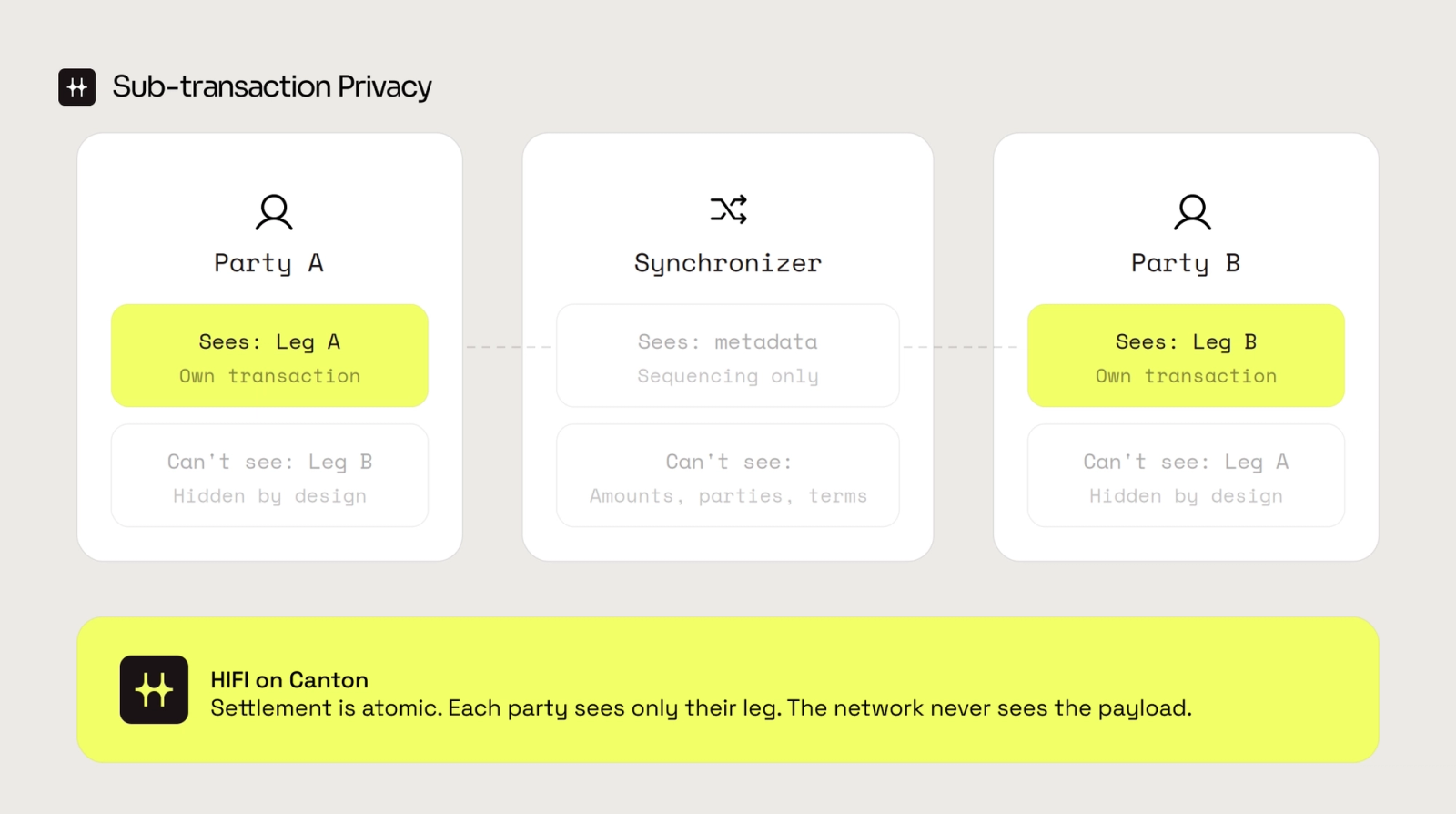
Purpose-built for regulated finance, Canton addresses privacy natively and operates at the sub-transaction level. A single settlement can span multiple applications and asset types, and each participant sees only their own leg of the transaction.
Transaction data flows directly between the validators involved in a settlement. The synchronizers that coordinate ordering route encrypted messages they can't decrypt. The network sees sequencing metadata but never amounts, counterparties, or contract terms.
Developers settling on Canton will use USDCx, a USDC-backed stablecoin live on Canton via Circle's xReserve. It's programmable, composable with other Canton applications, and maintains the privacy guarantees that make the network viable for institutional use.
Stablecoin payments through HIFI settle on Canton without exposing payment flows, counterparty relationships, or treasury positions to the network.
What this means for developers
HIFI abstracts Canton's settlement layer entirely. You don't need to write Daml contracts, run a validator node, or manage on-chain state. Payments route through Canton the same way they route through any other network HIFI supports, through a single API.
If your use case requires confidential payment flows, you can now route through infrastructure built for it, without changing your integration.
Programmable treasuries. Define sweep rules, payout conditions, and approval workflows. Canton enforces them at the smart contract level and keeps your cash-flow data confidential. HIFI handles the fiat disbursement.
Private cross-border settlement. Settle cross-border flows onchain without exposing counterparties, amounts, or routing to the rest of the network. HIFI connects onchain settlement to bank transfers and fiat payouts.
Repo and collateral settlement. Canton supports atomic delivery-versus-payment, eliminating principle risk. The securities leg and the cash leg settle together or not at all, with each side visible only to its counterparty. HIFI connects the cash side of these workflows to fiat rails and stablecoin liquidity, so the cash leg is funded and the settlement actually completes.
Bringing institutional settlement into one integration
HIFI builds payments infrastructure that works across banks, payment networks, and blockchains. The goal is a single API surface that handles routing, compliance, and settlement regardless of where the money moves.
Most public blockchain networks can handle the movement, but they lack the confidentiality that institutional counterparties require before they'll move anything meaningful. Adding Canton to HIFI's network coverage means developers can now route payments through infrastructure that meets institutional privacy requirements.
Get started
Canton is available today for developers building on HIFI.
Related Posts

 March 25, 2026
HIFI supports real-time payments
 March 20, 2026
TRON is live on HIFI