USDCx Bridging on HIFI: Moving USDC Between Ethereum and Canton
Dollar liquidity on Canton
The Canton Network is purpose-built for financial markets. Developers are using it to build tokenized bonds, repos, treasuries, and structured products, and those applications need a way to settle in dollars.
Circle elected to bring USDC to Canton via xReserve to allow Canton users to mint and use Canton-native stablecoins backed 1:1 by USDC reserves, while ensuring USDC interoperability with any network where USDC or USDCx is available. USDCx issued by Circle on Canton follows Canton's native token standard, ensuring composability with every application on the network.
Minting USDCx means coordinating wallets across Ethereum and Canton, handling Circle's attestation flow, tracking state through multiple asynchronous steps, and accounting for protocol-level fees. Burning back to USDC on Ethereum is the same process in reverse. For developers building settlement workflows or treasury operations, integrating xReserve directly means managing a significant chunk of cross-chain infrastructure that has nothing to do with their core product.
USDCx bridging on HIFI
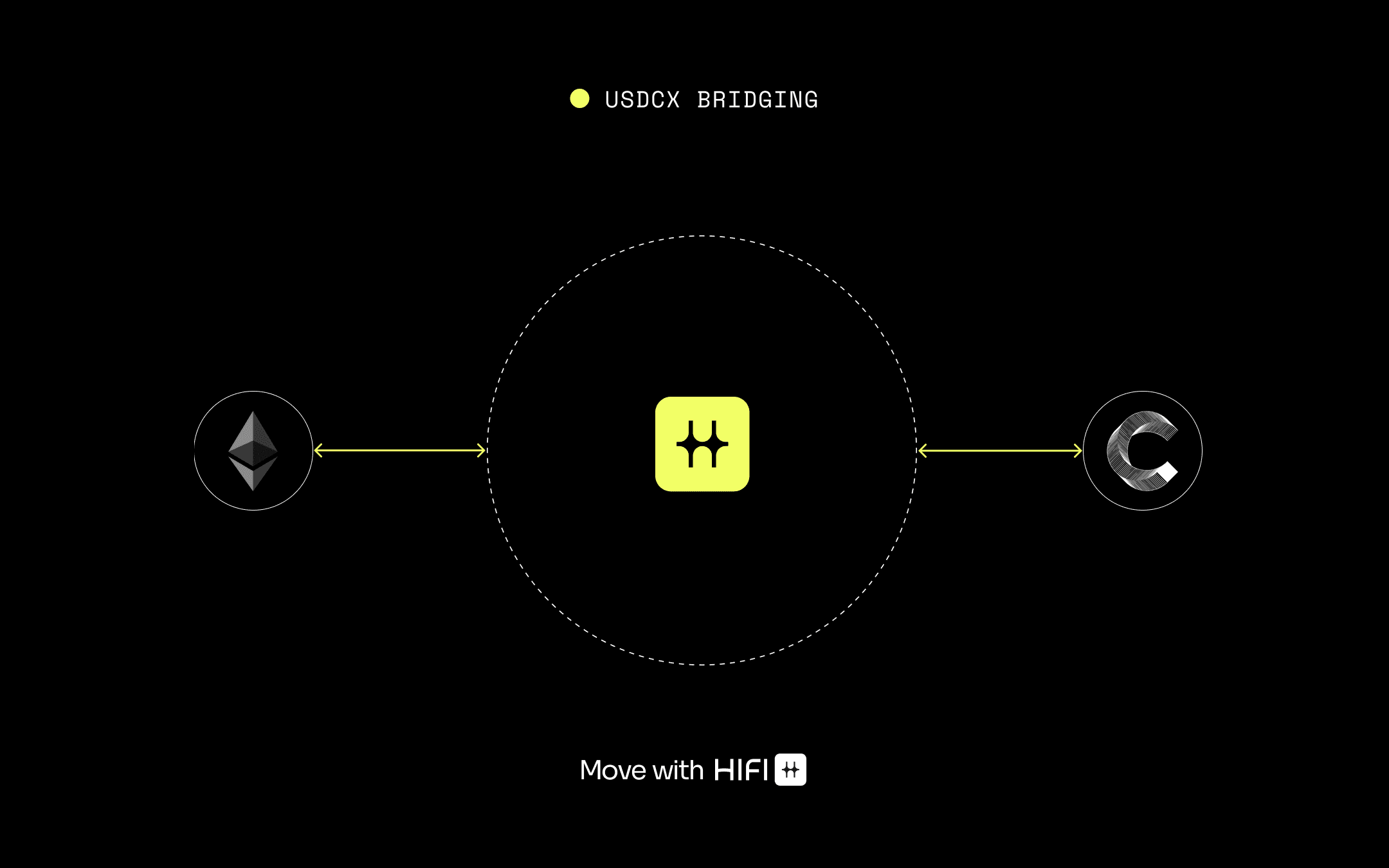
HIFI's bridging API abstracts the full xReserve flow into a single endpoint. Developers create a bridge request, receive a quote, and accept it to execute. The same endpoint handles both directions: Ethereum to Canton and Canton to Ethereum.
HIFI manages wallet coordination, attestation handling, and state tracking underneath. The quote response includes the exact amounts on both sides of the bridge, the exchange rate, and any rail fees, so you know what the recipient will receive before you commit.
Minting USDCx is free. Burns carry a flat 2 USDC fee to xReserve, which surfaces in the quote response as railFee so you can account for it programmatically.
What this means for developers
Developers on HIFI can move value between public blockchains and Canton without any infrastructure overhead.
USDCx bridging is available now in the HIFI sandbox.
Developer Docs: https://docs.hifi.com/features/canton/usdcx-bridging#usdcx-bridging
FAQs
What's the difference between USDC and USDCx?
USDC is Circle's dollar-backed stablecoin native to public blockchains like Ethereum. USDCx is the Canton-native version of USDC issued via Circle's xReserve, giving Canton applications the same 1:1 backing in a form composable with Canton's privacy model.
What is xReserve?
xReserve is Circle's mechanism for bringing USDC to Canton, letting Canton users mint and use Canton-native stablecoins while maintaining USDC interoperability with networks where USDC or USDCx is available.
How does HIFI's USDCx bridging work?
HIFI's bridging API abstracts the full xReserve flow into a single endpoint. Developers create a bridge request, receive a quote, and accept it to execute, while HIFI manages wallet coordination, attestation handling, and state tracking underneath.
Does HIFI's bridging API support both directions between Ethereum and Canton?
Yes. The same endpoint handles both directions, Ethereum to Canton and Canton to Ethereum.
How much does it cost to mint USDCx through HIFI?
Minting USDCx through HIFI is free.
How much does it cost to burn USDCx back to USDC?
Burning USDCx back to USDC carries a flat 2 USDC fee to xReserve.
